The Umbwe Route — Kilimanjaro's Most Direct Challenge
Overview
Daily summary
Day-by-day itinerary
Prices
FAQs
Where is the extra acclimatisation night?
The approved seven-day itinerary spends two consecutive nights at Barranco Camp. Day 3 is a full acclimatisation and rest day at Barranco — the second overnight there — before the route continues to Karanga. No specific excursion, distance or altitude gain is scheduled for that day.
What happens at Barafu before the summit attempt?
On Day 5 you reach Barafu Camp, the last camp before the summit. There is no full rest day; the afternoon is used to rest, eat an early dinner and prepare clothing, headlamps and water for the midnight summit departure.
Which camp follows the summit?
After summiting Uhuru Peak, you descend to Millennium Camp for the final night on the mountain. The next morning you walk out to Mweka Gate, complete park formalities and transfer to Moshi.
Elevation:
Distance:
Time:
Habitat:
Umbwe Gate to Umbwe Cave Camp
The Umbwe Route begins with a steep, direct ascent through dense, undisturbed rainforest. The narrow trail climbs a long ridge between two rivers — the Umbwe and the Lonzo — gaining altitude rapidly. Umbwe Cave Camp, a natural lava cave offering basic shelter, marks the first overnight stop. This is one of the steepest forest sections on the mountain.
Umbwe Cave Camp to Barranco Camp via the Umbwe Ridge
The trail continues sharply upward along the Umbwe Ridge — one of Kilimanjaro's most dramatic and direct lines. The ridge narrows with steep drops on both sides as it climbs through moorland into the alpine desert. The Southern Glaciers come into view as the path finally drops to Barranco Camp beneath the Barranco Wall. This is one of the most physically demanding single days on the mountain, and the first of two nights at the same camp.
Acclimatisation day at Barranco Camp
A full day at Barranco with no scheduled trekking stage. Its purpose is acclimatisation and rest: after the fast gain of the first two days, the extra night lets your body adjust before the route climbs higher toward Karanga and Barafu. The day is deliberately unstructured — your guide sets the pace, checks in on how everyone is feeling and agrees with the group how the hours are used. The second night is spent at Barranco Camp.
Barranco Camp to Karanga Camp
The morning begins with the Barranco Wall — a celebrated rock scramble requiring hands and feet, assisted by the guide team. Non-technical but exhilarating, the Wall rewards climbers with dramatic views of the southern ice fields. From the top, the trail crosses a series of ridges to Karanga Camp — a shorter stage that keeps the day gentle after the rest day at Barranco.
Karanga Camp to Barafu Camp
From Karanga the route climbs through bare, rocky alpine desert to Barafu Camp, the last camp before the summit, with Mawenzi and Kibo filling the skyline. There is no full rest day here on the approved itinerary: the afternoon is used to rest, drink, eat an early dinner and prepare for the overnight summit attempt — kit laid out, bottles filled, head torches checked — before an early night.
Barafu Camp to Uhuru Peak to Millennium Camp
The summit attempt begins overnight, climbing steep scree by head torch to Stella Point on the crater rim. After a short rest and sunrise, the path continues to Uhuru Peak — Africa's highest point at 5,895m. Following summit photographs, we descend to Barafu for a brief rest, then continue down to Millennium Camp for the last night on the mountain. A long, extraordinary day.
Millennium Camp to Mweka Gate, then transfer to Moshi
After breakfast and the crew farewell, we descend through moorland and rainforest to Mweka Gate. The lower trail can be muddy after rain — trekking poles and gaiters are useful. Park formalities and summit certificates are completed at the gate, then our vehicle transfers the group back to Moshi for a hotel night and a well-deserved celebration. That hotel night is separate from the six mountain overnights.
Northern Circuit
Moderate
Exceptional
Very Low
Very High
Lemosho
Medium
High
Rongai
Very Good
Low
Good
Machame
Moderate–Challenging
Excellent
Shira
Challenging
Marangu
Umbwe
Very Challenging
Dramatic
Our 7-day itinerary adds a Barranco night
Umbwe Route — Kilimanjaro Climb | Exuberant Kilimanjaro
Climb Kilimanjaro via the direct and demanding Umbwe Route — the steepest and most dramatic ascent on the mountain, ascending a sharp ridge with very few other climbers over 7 challenging days.
Kilimanjaro Climb Routes
The steepest, most direct and least-trafficked route on Kilimanjaro — a dramatic ridge ascent for experienced, fit climbers who seek a raw, uncompromising mountain experience over 7 demanding days.
Exuberant Kilimanjaro
Route Overview
Why choose the Umbwe Route?
The Umbwe Route is Kilimanjaro's most direct and physically demanding line. From the south-west trailhead it climbs a narrow ridge through undisturbed rainforest and open moorland to Barranco Camp, gaining height quickly and leaving little time to settle at altitude. That makes it a poor choice for a first high-altitude trek and a genuinely rewarding one for fit, experienced climbers. Very few groups use the route, so the mountain feels quiet. Our approved seven-day itinerary spends two consecutive nights at Barranco, giving a full day for acclimatisation and rest before the climb continues through Karanga and Barafu. Six nights are spent on the mountain; hotel nights in Moshi are arranged separately before and after the trek. The descent follows the Mweka trail.
Important Notes
Duration
Summit Elevation
Difficulty
Traffic
How the altitude builds
The defining characteristic of this route is how fast it gains height: the first two days climb from the trailhead to Barranco Camp at 3,960m/13,000ft. Because that is a rapid gain, the approved seven-day schedule stays a second night at Barranco so the body has time to adjust before the climb moves higher through Karanga and Barafu. The altitude of each camp is listed day by day below, and the summit attempt follows directly from Barafu.
Route Map
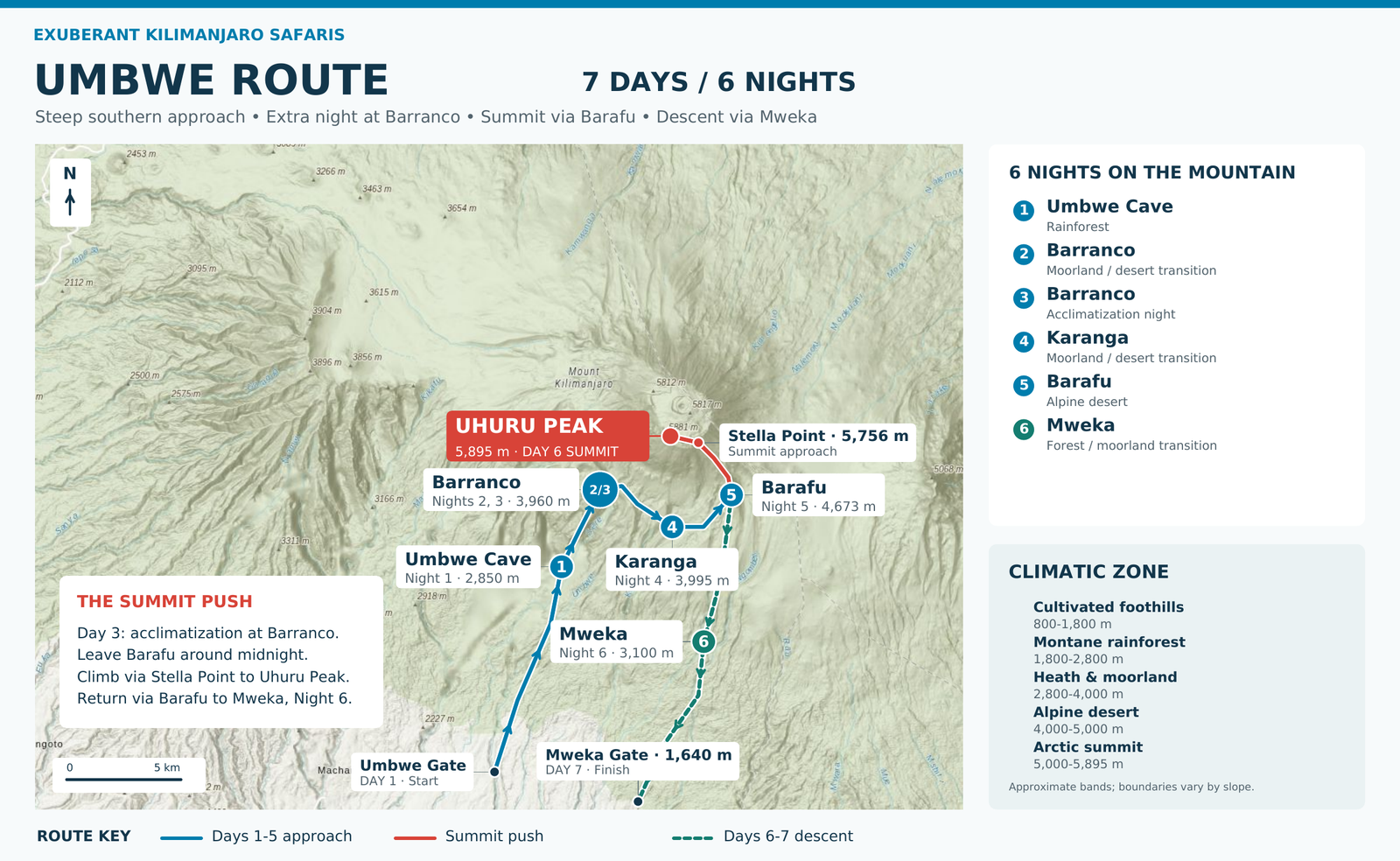
Umbwe Route Map — 7 Days / 6 Nights
Umbwe Route map on a relief map of Kilimanjaro showing seven days and six mountain nights: Umbwe Cave, two nights at Barranco, Karanga, Barafu, the summit at Uhuru Peak via Stella Point, and the Mweka descent.
The map follows the approved sequence above: an extra night at Barranco (nights 2 and 3), then Karanga, Barafu, the summit push to Uhuru Peak and the Mweka descent on Day 7.
View full-size Umbwe map
Day by Day at a Glance
7 Days Standard Umbwe Itinerary
Standard Umbwe 6 Days
Standard Umbwe 7 Days
Umbwe Pricing
Compare Routes
How does the Umbwe Route compare?
Route
Minimum Days
Recommended Days
Scenery
Umbwe FAQs
Route-specific questions
Umbwe pricing
2026–2027 standard trek rates · USD per person, based on the number of climbers travelling together.
| Variation | 1 person | 2 people | 3–4 people | 5+ people |
|---|---|---|---|---|
| Standard Umbwe 6 Days ★ | $2,000 | $1,870 | $1,790 | $1,695 |
An obligatory crew tip of at least US$600 per participant is payable in addition to the trek price. Other exclusions and applicable supplements also apply.