Kilimanjaro Wildfires 2026: One Team, One Mountain | Exuberant Kilimanjaro Safaris
Discover how guides, porters, rangers and tourism operators joined forces to fight Kilimanjaro's 2026 wildfires and protect the mountain.
Exuberant Kilimanjaro Safaris
Kilimanjaro Wildfires 2026: One Team, One Mountain | Exuberant Kilimanjaro Safaris
Mountain Life & Conservation
One Team. One Mountain.
Long before you see the flames on Kilimanjaro, you may smell the smoke.
It drifts across the mountain, carried by the wind through a landscape most travellers know from summit photographs.
But for the guides, porters, rangers and mountain crews who have spent years walking these trails, smoke means something different.
It means watching the wind.
Watching the grass.
Watching the direction of the fire.
And knowing that somewhere ahead, people may have to walk towards something everyone else is trying to escape.
When Kilimanjaro Burns, the Mountain Community Responds
During September 2026, wildfires affected different areas of Mount Kilimanjaro, including the Kikelewa region on the northeastern slopes and the Sangarini–Kamwanga area towards Shira.
The outbreaks brought together conservation authorities, firefighters, tourism stakeholders, guides, porters and neighbouring communities.
For Exuberant Kilimanjaro Safaris, protecting the mountain is more than a conservation slogan.
It is personal.
Our teams work on these trails. Our livelihoods depend on the mountain’s health. And our communities live with the consequences when its vegetation burns.
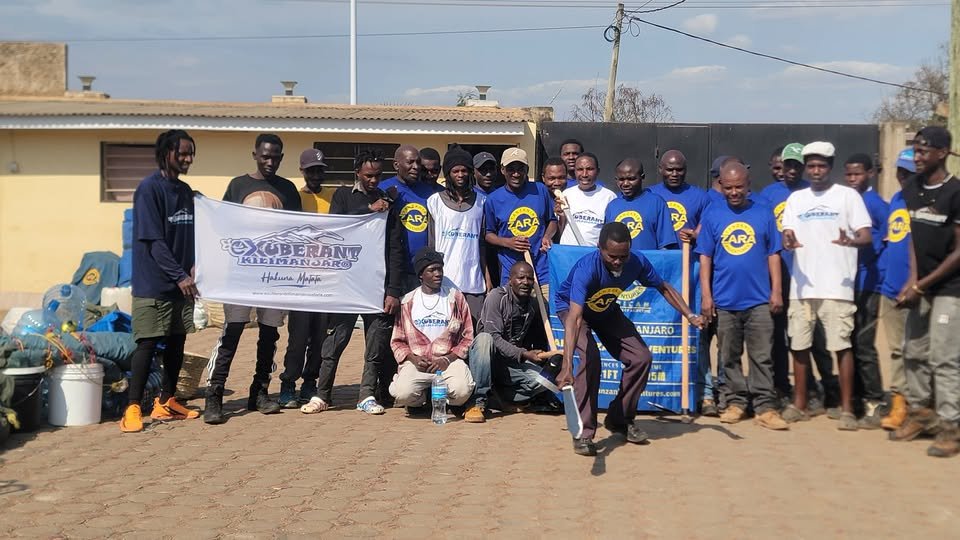
Team Zara and Team Exuberant Kilimanjaro joined forces on the ground as part of the wider firefighting response.
Different companies. Different uniforms. One mountain.
Firefighting on Kilimanjaro Is Hard Physical Work
When people imagine fighting a wildfire, they may picture helicopters releasing enormous quantities of water over burning forests.
But on Kilimanjaro, much of the response depends on people working directly on the terrain.
Armed with shovels, machetes and other available tools, responders clear vegetation to create firebreaks.
The principle is straightforward: remove combustible material before the advancing flames reach it.
The reality is far more demanding.
Imagine cutting through dry vegetation on uneven mountain slopes, breathing smoky air, carrying equipment and constantly monitoring the wind.
Conditions can change quickly.
A shift in wind direction can threaten an area that appeared safe minutes earlier.
Every metre of firebreak requires effort. Every responder needs water, food, equipment, transport, coordination and rest.
Firefighting is not simply about courage. It is also about preparation, experience and working together under difficult conditions.
Kilimanjaro Is More Than Its Summit
Most people associate Kilimanjaro with Uhuru Peak at 5,895 metres.
But the mountain is an extraordinary ecosystem extending far below the summit.
Its lower cultivated slopes give way to montane forest, heath and moorland, alpine desert and finally the rocky, icy summit environment. Each ecological zone supports its own vegetation and wildlife — read more in our guide to Kilimanjaro’s flora & fauna .
And fire does not respect those boundaries.
When vegetation burns, the effects extend beyond what can be seen in photographs.
Wildlife may lose feeding areas, shelter and established movement routes.
Larger animals may be able to escape advancing flames, although they can still be displaced.
Small mammals, reptiles, insects and other ground-dwelling organisms may have fewer opportunities to move away.
Birds may temporarily abandon affected habitats.
The consequences can continue long after the flames disappear.
Grass may regenerate relatively quickly. Other vegetation, habitats and soil conditions can take much longer to recover.
That is why the impact of a Kilimanjaro wildfire cannot be understood only by counting the hectares burned.
We must also consider what those hectares contained.
Habitat.
Vegetation.
Wildlife.
Water catchment.
And an environment that supports livelihoods across the Kilimanjaro region.
The People Behind the Firebreaks
There is something remarkable about seeing members of the mountain tourism community working together outside their normal responsibilities.
Guides who usually lead climbers towards the summit.
Porters who normally carry expedition equipment — the same crew members you can meet here and read about in our porter welfare commitments.
Rangers responsible for protecting the national park.
Tourism operators who ordinarily compete for the same customers.
During a wildfire response, those differences become much less important.
What matters is the immediate work.
Clearing vegetation.
Supporting other responders.
Following instructions from the authorities coordinating the operation.
Protecting the mountain.
The photograph accompanying this article captures members of Team Zara and Exuberant Kilimanjaro Safaris coming together during the firefighting response.
It is a reminder that the tourism industry is not separate from Kilimanjaro’s conservation.
We are part of the mountain community.
And with that comes responsibility.
Why Prevention Matters as Much as Firefighting
Kilimanjaro has experienced serious wildfires before.
Repeated outbreaks raise questions that deserve sustained attention.
Where are fires most likely to start?
Which activities create the greatest ignition risks?
How can patrols and early detection be strengthened during dry periods?
Where would better access to firefighting equipment make the biggest difference?
Can guides, porters and surrounding communities receive more practical wildfire-response training before emergencies occur?
And how can tourism operators work more closely with park authorities on prevention and preparedness?
These questions are not about assigning blame before investigations are complete.
They are about reducing the likelihood and consequences of future fires.
Because responding to an established wildfire is difficult.
Preventing a small ignition from becoming a major emergency is an even more important goal.
Protecting the Mountain That Supports Us
Kilimanjaro is a source of pride for Tanzania and an extraordinary destination for visitors from around the world.
But for those of us who live and work here, it is also part of everyday life.
Its forests, trails and surrounding communities are interconnected.
A fire on the mountain affects more than the landscape seen from Moshi.
It threatens ecosystems, demands significant conservation resources and can disrupt tourism activities that support thousands of livelihoods.
At Exuberant Kilimanjaro Safaris, we believe that responsible tourism includes supporting the protection of the places where we operate — a commitment that runs alongside our community responsibility and porter welfare work.
We recognise the work of Tanzania National Parks Authority (TANAPA), emergency responders, mountain crews, fellow tourism operators, volunteers and surrounding communities involved in protecting Kilimanjaro.
And we acknowledge everyone who has contributed time, energy and resources during these difficult operations.
One Team. One Mountain.
Perhaps the most powerful image of Kilimanjaro’s wildfires is not the flames.
It is the people responding to them.
People who usually spend their days helping others achieve a dream suddenly working together to protect the mountain that makes those dreams possible.
The summit will still be there tomorrow.
The question is what kind of mountain will remain beneath it.
Because Kilimanjaro is more than Uhuru Peak.
It is every forest, ridge, stream, animal, trail and community below it.
Protecting the mountain cannot begin only when smoke appears.
The greatest achievement will be a season when nobody needs to walk towards the flames.
Mpaka Moto Uishe!
Keep reading & learn more
Meet your Kilimanjaro mountain crew
Porter welfare
Community responsibility
Kilimanjaro flora & fauna
Kilimanjaro climate zones & weather
Kilimanjaro beginner’s guide
All blog & resources